


Why Steel Formwork Dominates Precast Concrete Production
When you are producing the same precast element hundreds of times, the formwork stops being a temporary mould and becomes a production machine. Steel formwork for precast concrete is built from Q235 carbon steel with panels typically 3–6 mm thick, fully welded ribs and stiffeners, and a dimensional tolerance of ±0.5 mm. That combination is what allows a precast plant to strip a panel, clean it, oil it, and pour again the same day without the mould losing its geometry. Timber or plywood forms might survive 10–15 pours; steel moulds deliver 60–100 reuses in standard designs and 120+ reuses in heavy-duty designs. The arithmetic is simple: if a steel mould costs three times a timber mould but lasts eight times as long, the cost per pour drops by more than half. But not every precast operation should buy steel. This article explains the selection criteria we see from the workshop side, including when steel is the wrong choice.
Panel Thickness and Stiffener Design: The Core Trade-off
The first decision is panel thickness. A 3 mm panel is light and cheap, but it deflects under vibration and can oil-can between stiffeners. A 6 mm panel resists deflection but adds weight and cost. For most precast elements—wall panels, beams, columns, stairs—4–5 mm is the sweet spot. The stiffeners matter as much as the panel. We weld 50 × 50 × 5 mm angle ribs at 300–400 mm centres, depending on the pour rate. If you pour at 2 m/hr or faster, you need ribs at 300 mm centres and a panel of at least 5 mm. If you pour slowly at 0.5 m/hr, 400 mm centres with a 4 mm panel is adequate. The table below compares three common configurations.
| Configuration | Panel Thickness | Stiffener Spacing | Max Pour Rate | Typical Reuse | Relative Cost |
|---|---|---|---|---|---|
| Light-duty | 3 mm | 500 mm | 0.5 m/hr | 60–80 | Low |
| Standard | 4–5 mm | 400 mm | 1.5 m/hr | 80–100 | Medium |
| Heavy-duty | 6 mm | 300 mm | 3 m/hr | 120+ | High |
Notice that the heavy-duty option is not just about thickness; it is about the whole system. The ribs are closer, the welds are larger, and the stripping sequence is designed to avoid hammering. If your production schedule requires 3 m/hr pour rates, you cannot compromise on the heavy-duty design. If you pour at 0.5 m/hr and only need 50 reuses, the light-duty mould is the rational choice.
Welding Quality and Jig Assembly: What to Inspect
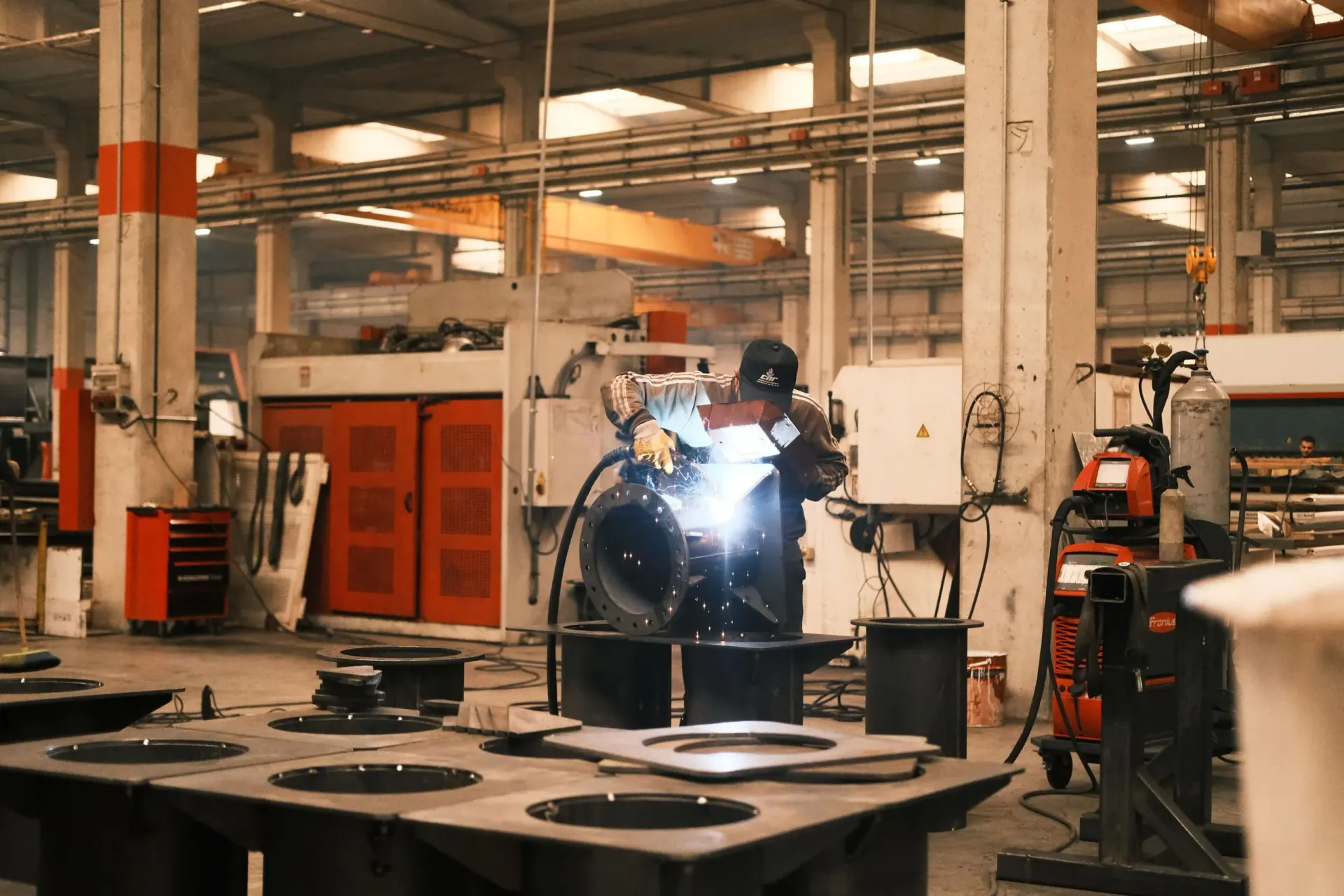
Steel formwork fails at the welds long before the steel itself wears out. We use CO2 gas shielded welding with a 1.2 mm wire, and every rib is welded on both sides with a 4–5 mm fillet. The panel-to-frame weld is continuous, not stitch-welded, because stitch welds allow concrete slurry to penetrate and cause corrosion. When you inspect a mould, look for:
- Weld size and continuity: A 4 mm fillet weld should be uniform along the entire rib. Undercut or porosity is a reject.
- Jig assembly accuracy: The mould should be assembled in a jig that holds diagonals within ±1 mm. If the jig is worn, the mould will be twisted.
- Bolt torque: For modular moulds, bolts should be torqued to 80–100 Nm for M12 grade 8.8. Under-torquing causes gaps; over-torquing strips threads.
- Surface finish: The concrete face should be ground smooth and free of pits. A Ra 3.2 µm finish is typical for architectural precast.
We also stress-relieve large moulds after welding to prevent distortion during the first few pours. This is a step many low-cost suppliers skip, and it shows up as a mould that is 2–3 mm out of tolerance after 20 pours.
Tolerance and Stripping: The Hidden Cost Drivers
Tolerance is not just a number on a drawing; it determines whether your precast elements fit on site. For a 6 m long wall panel, a ±0.5 mm mould tolerance translates to a ±1 mm element tolerance after shrinkage and handling. If you accept a ±2 mm mould tolerance, your elements may be ±4 mm, which can cause problems with joint widths and facade alignment. The stripping sequence is equally important. We design moulds with hinged side plates and integrated lifting lugs so that the element can be stripped without prying against the concrete. A typical stripping sequence for a wall panel is:
- Loosen the side plate bolts in a diagonal pattern, not sequentially.
- Use the built-in jacking screws to separate the side plates by 5–10 mm.
- Lift the panel vertically with a certified lifting frame; do not drag it.
- Clean the mould face immediately with a soft scraper and apply release agent.
If your crew skips step 2 and uses a hammer, the mould will lose tolerance within 10 pours. We have seen plants destroy a USD 8,000 mould in three months because of improper stripping.
Cost per Reuse: The Only Comparison That Matters
Buyers often ask for the price of a mould. The better question is the cost per reuse. A standard steel mould for a 3 m × 1.5 m wall panel might have a typical market range of USD 1,200–2,500 depending on thickness and stiffeners. If it delivers 80 reuses, the cost per pour is USD 15–31. A timber mould for the same panel might cost USD 400–600 but last only 10–15 pours, giving a cost per pour of USD 27–60. Steel wins on arithmetic, but only if you actually achieve the reuse count. To do that, you need:
- Proper storage: Moulds should be stored on a flat rack, not stacked directly on the ground.
- Regular maintenance: Check bolt torque every 20 pours and touch up welds if you see rust bleeding.
- Release agent: Use a water-based release agent, not diesel, which attacks the steel.
If your production volume is below 20 pours per year, steel may not pay back. In that case, a high-quality plywood or plastic mould is more economical. But for any precast plant producing repetitive elements, steel is the lower-cost option over a 12-month horizon.
Lead Time, Payment, and Shipping: What to Expect
Lead time depends on whether the mould is a stock design or customised. Stock moulds ship in 7–10 working days after deposit. Customised formwork takes 15–25 working days after deposit, because we need to fabricate the jig, weld the frame, and stress-relieve. We have no MOQ, so you can order one mould or one hundred. Payment is 30% deposit by T/T, balance against copy of B/L. We provide CI, PL, MTC, CO, and FORM E for ASEAN buyers. Shipping is FOB Tianjin, with CIF or CFR available on request. A standard 3 m × 1.5 m mould fits in a 20 ft container; larger moulds may require a 40 ft container or flat rack. Always ask for a packing list with dimensions and weights before you book freight.
When Steel Formwork Is the Wrong Choice
Steel formwork is not universal. Do not choose steel if:
- You produce fewer than 20 elements per year. The capital cost cannot be amortised.
- Your elements have complex, non-repeating geometry. Custom steel moulds are expensive to modify; timber is more flexible.
- You lack lifting equipment. A 3 m × 1.5 m steel mould can weigh 250–400 kg, requiring a forklift or crane.
- You cannot maintain tolerances. If your crew is not trained in proper stripping and cleaning, steel will not deliver its reuse potential.
In these cases, a hybrid approach—steel base with timber sides—may be the best compromise. But for high-volume precast production, steel formwork is the only system that delivers the tolerance, finish, and cost per reuse that modern projects demand.
Final Selection Checklist
Before you request a quotation, gather these details: element dimensions, concrete mix, pour rate, required tolerance, surface finish, number of reuses, and available lifting equipment. With that information, any reputable supplier can recommend the right panel thickness and stiffener spacing. Remember that the cheapest mould is rarely the lowest-cost mould. Focus on the cost per reuse, the welding quality, and the stripping design. If you need a starting point, our standard 4 mm panel with 400 mm stiffener spacing handles most precast wall and beam applications at pour rates up to 1.5 m/hr. For anything faster or more demanding, step up to the heavy-duty design. The difference in price is typically 20–30%, but the difference in uptime and tolerance is far greater.