


Why Steel Formwork Selection Starts at the Welding Bench
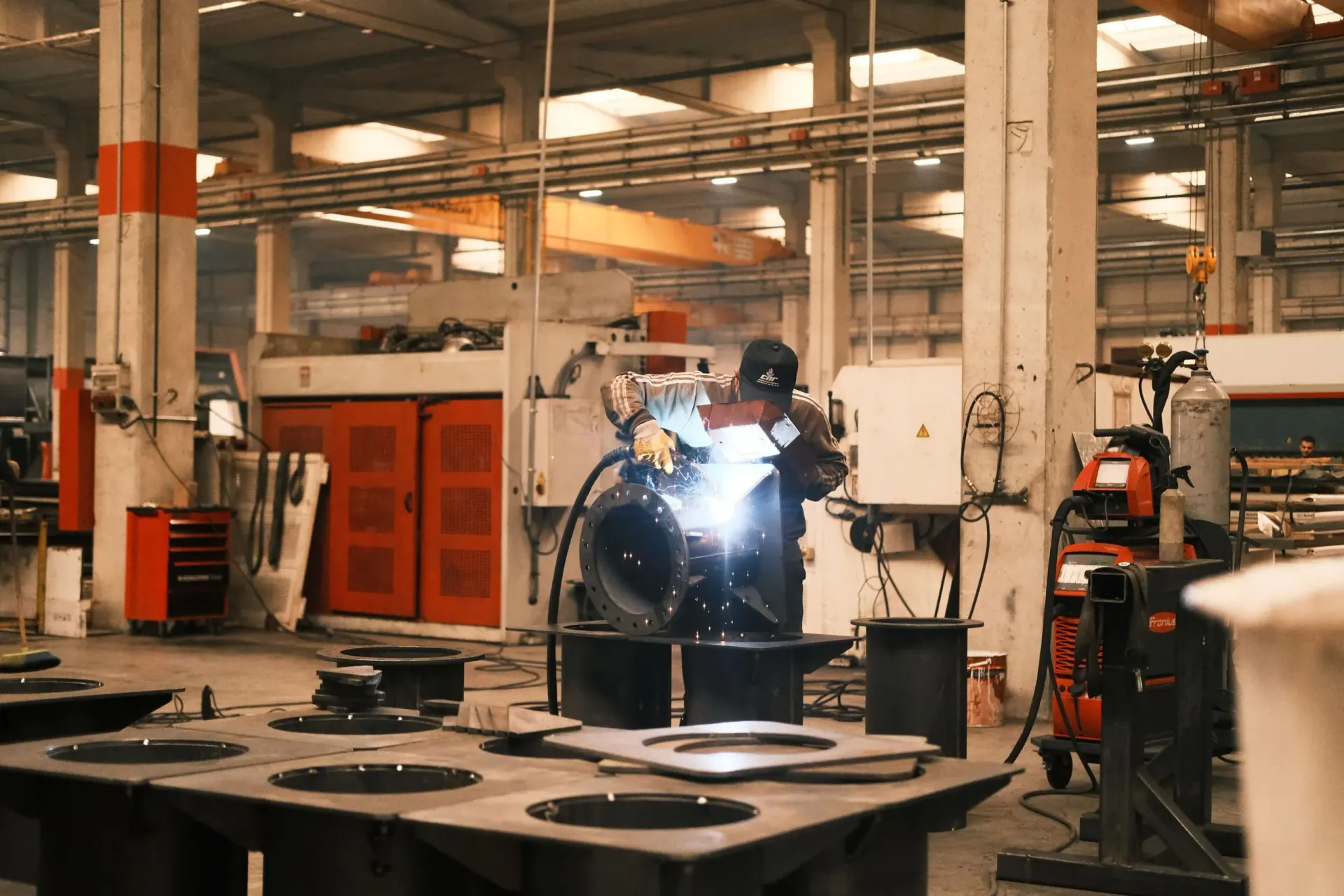
When you buy steel formwork for precast concrete production, the first decision is not price per square metre—it is whether the mould can hold ±0.5 mm tolerance through repeated pours. That tolerance is set by the welding jig, not by the steel grade alone. A 3 mm panel welded to a 50×50×5 mm angle rib on a rigid jig will stay flatter after 60 reuses than a 6 mm panel welded freehand. The jig controls distortion; the panel thickness only resists it. So when you evaluate a supplier, ask to see their jig setup and their post-weld straightening process. If they cannot describe how they control angular distortion during rib welding, the tolerance claim is marketing, not manufacturing.
Panel Thickness and Rib Design: The Real Trade-offs
Steel formwork panels are typically 3–6 mm thick, fully welded to ribs and stiffeners. The choice depends on your pour rate and the number of reuses you need. A 3 mm panel with 40×40×4 mm ribs at 300 mm centres will handle a pour rate of 1.5 m/hr and give you 60–80 reuses. A 5 mm panel with 60×60×6 mm ribs at 250 mm centres will handle 3 m/hr and exceed 120 reuses. The heavier mould costs roughly 25–35% more upfront, but the cost per pour drops from about $12 to $7 when you spread it over 120 reuses instead of 60. That arithmetic matters more than the invoice price.
But heavier is not always better. If your crane capacity is limited to 5 tonnes and your panel is 6 m × 3 m, a 6 mm mould with heavy ribs can weigh 1.8 tonnes, leaving little margin for concrete and lifting gear. In that case, a 4 mm panel with a well-designed rib grid is the better choice. The rib spacing, not the panel thickness, determines stiffness. A 4 mm panel with ribs at 200 mm centres can be stiffer than a 6 mm panel with ribs at 400 mm centres.
How Pour Rate Limits Are Calculated (and Why They Matter)
Pour rate is the speed at which concrete rises in the mould. It creates hydrostatic pressure that tries to bow the panel. The pressure at the bottom of a 3 m pour is roughly 72 kPa for normal-weight concrete. A 3 mm panel with ribs at 300 mm centres will deflect about 1.5 mm at that pressure—acceptable for many precast panels but not for architectural finishes. A 5 mm panel with ribs at 250 mm centres deflects less than 0.5 mm. That is why architectural precast plants almost always choose 5–6 mm panels, while producers of utility panels or drainage units can use 3–4 mm.
If you exceed the safe pour rate, you will see bulging, which shows up as a wavy surface on the finished panel. You will also stress the welds. A mould that is over-poured may survive, but its reuse life drops by 30–40%. So the pour rate limit is not a suggestion—it is a warranty condition. Ask your supplier for the maximum pour rate for each mould design, and make sure your concrete crew respects it.
Stripping Sequence and Bolt Torque: The Hidden Cost Drivers
The stripping sequence determines how fast you can turn around a mould. A well-designed steel formwork uses tapered pins and wedge bolts that release with a few hammer taps. A poor design uses standard bolts that require a wrench on every connection. On a 6 m × 3 m panel with 24 bolts, the difference is 15 minutes per strip. Over 100 reuses, that is 25 hours of labour—enough to justify a higher upfront price for a better design.
Bolt torque matters for two reasons: it controls panel alignment and it prevents concrete leakage. For M16 bolts, the recommended torque is 80–100 Nm. Under-torquing causes grout loss and edge damage; over-torquing strips the threads and deforms the bolt holes. After 20 reuses, bolt holes can ovalise by 0.3–0.5 mm, which affects alignment. A good supplier will provide replacement bolts and recommend a torque wrench for the first 10 reuses until your crew develops the right feel.
Comparing Steel Formwork Options: A Buyer's Table
The table below compares three common steel formwork configurations for precast concrete production. Use it to match the mould to your pour rate, crane capacity, and reuse target.
| Configuration | Panel Thickness | Rib Spacing | Max Pour Rate | Reuse Cycles | Typical Weight (6m x 3m) | Best For |
|---|---|---|---|---|---|---|
| Light-duty | 3 mm | 300 mm | 1.5 m/hr | 60–80 | 0.9 tonnes | Utility panels, short runs |
| Standard-duty | 4–5 mm | 250 mm | 2.5 m/hr | 80–100 | 1.3 tonnes | General precast, walls, slabs |
| Heavy-duty | 6 mm | 200 mm | 3.5 m/hr | 120+ | 1.8 tonnes | Architectural, high-volume |
Note: weights are approximate and vary with rib size and lifting points. Always confirm crane capacity before ordering heavy-duty moulds.
When NOT to Choose Steel Formwork
Steel formwork is not always the right answer. If you are producing fewer than 20 identical precast units, a plywood or timber mould may be more economical. A steel mould for a 6 m × 3 m panel costs $2,800–$4,500 (typical market range) and takes 15–25 working days to manufacture after deposit. A plywood mould can be built in 2–3 days for under $800. The break-even is around 25–30 reuses. Below that, steel is overkill.
Also, if your production floor has no overhead crane or forklift with sufficient capacity, heavy steel moulds become a safety risk. A 1.8-tonne mould that is moved by manual pallet jack is an accident waiting to happen. In that case, choose lighter 3 mm moulds or consider modular aluminium formwork, which is lighter but has a shorter reuse life (typically 40–60 cycles).
Lead Times, Payment, and Documentation: What to Expect
For stock moulds, lead time is 7–10 working days after deposit. For customised formwork, expect 15–25 working days after deposit, depending on complexity and current workshop load. Payment terms are typically 30% deposit by T/T, balance against copy of B/L. We accept FOB Tianjin, and CIF/CFR are available on request. There is no MOQ—you can order one mould or one hundred.
Documents provided include CI, PL, MTC, CO, and FORM E. The MTC (Material Test Certificate) is important because it confirms the steel grade. We use Q235 carbon steel for all standard moulds. If you need higher strength, we can supply Q345, but it is rarely necessary for precast formwork and adds 10–15% to the cost. Always check that the MTC matches the steel grade you ordered—some suppliers substitute lower grades without telling you.
Maintenance and Reuse: How to Get 100+ Cycles
To reach 100+ reuses, you must maintain the mould. After each strip, clean the concrete residue with a soft scraper—never a hammer. Apply a release agent before each pour. Check bolt torque every 10 reuses. Inspect welds for cracks every 50 reuses. If you see a crack, stop using the mould and repair it. A cracked rib can fail suddenly under hydrostatic pressure.
Store moulds on a flat surface, not on the ground. Moisture causes rust, which pits the panel surface and transfers to the concrete. A rusty mould produces a stained panel. If you store outdoors, cover with a tarp and apply a rust-preventive oil. With proper care, a heavy-duty steel mould can last 150 reuses or more. Without care, even a 6 mm mould may fail at 40 reuses.
Making the Final Decision
Start with your production plan. How many units per week? What is your crane capacity? What surface finish do you need? Then match the mould configuration to those answers. Do not buy heavy-duty moulds if you only need 50 reuses—you will pay more and lift more weight for no benefit. Do not buy light-duty moulds if you need architectural finishes—you will fight deflection and reject panels. The right steel formwork is the one that balances upfront cost, pour rate, and reuse life for your specific precast operation.