
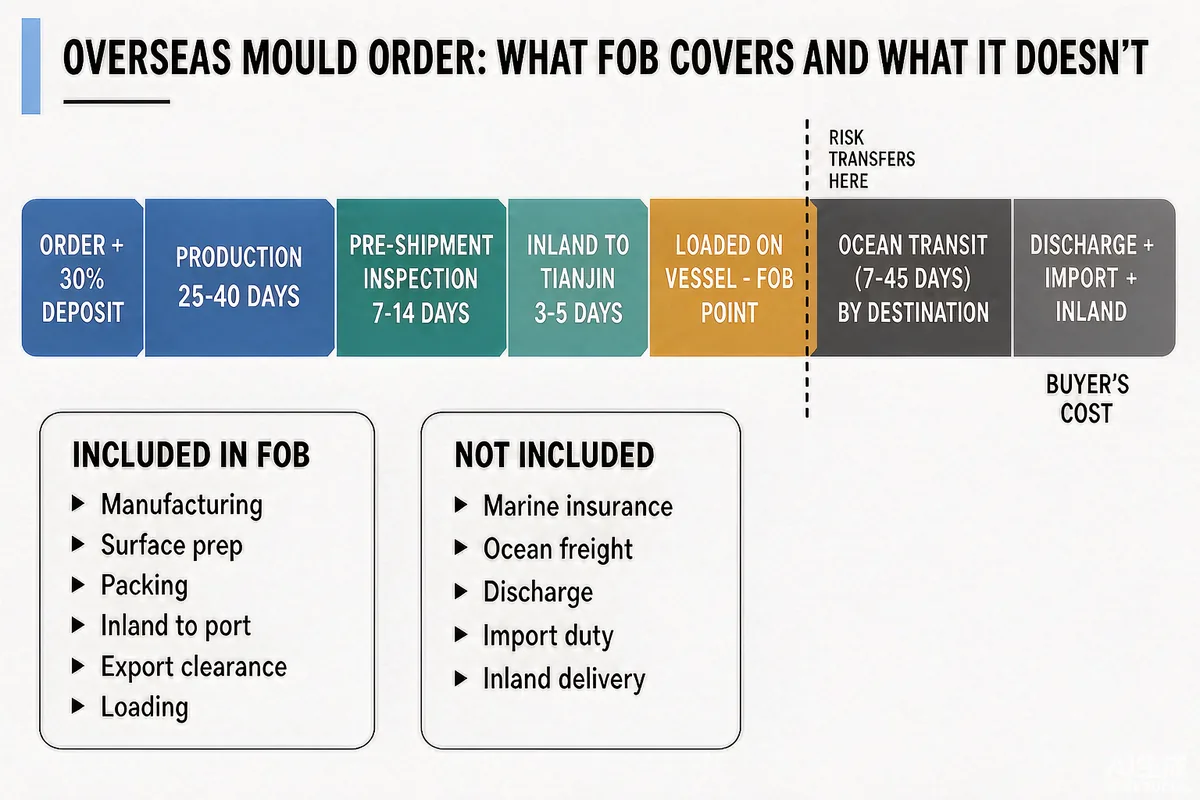
Buying a fabricated steel mould from overseas is not complicated, but the failure points are all in logistics rather than in the manufacturing. Here is what each stage actually involves, based on our own shipping records.

What FOB Tianjin covers, and what it does not
FOB (Free On Board) means the seller's responsibility ends when the goods are loaded on the vessel at the named port. In practice, for our quotations, FOB includes:
- Manufacturing and workshop assembly check
- Surface preparation and protective painting
- Packing into the container configuration agreed with the buyer
- Inland transport from the factory to Tianjin port
- Export customs clearance in China
- Loading onto the vessel
FOB does not include: marine insurance, ocean freight, discharge at destination, destination port charges, import duty, inland transport at your end, or unloading at your site. Those are typically 20-40% of the FOB value, so budget them before comparing suppliers on price alone.
If your purchasing department needs a delivered price, ask for CIF your port — we quote it routinely and it is usually clearer than trying to estimate freight yourself. Note that CIF puts the risk transfer at the same point as FOB for insurance purposes; if you need risk to transfer at destination, that is CIP.
Pre-shipment inspection: what to insist on
An inspection before the container is sealed is the single highest-value thing you can arrange. Three options, in increasing cost:
| Option | Coverage | Typical cost |
|---|---|---|
| Photo and video report from the factory | Trial assembly, dimensions to tape, weld close-ups | Free — ask for it in writing at order stage |
| Third-party inspection (SGS, BV, TÜV) | Independent dimensional verification, visual weld check, packing check | USD 300 – 800 per manday plus travel |
| Buyer's own engineer on site | Full witness of trial assembly and measurement | Travel and time cost, best value on first orders |
Whatever the route, the inspection report must record:
- Internal dimensions with the mould fully assembled and bolted — not panel dimensions measured loose.
- Diagonals on every rectangular section.
- A straight-edge check of panel flatness, with a figure in mm per 2 m.
- The core collapsing and re-erecting on camera.
- All parts laid out and counted against the packing list.
- Photographs of the inside faces of panels after cleaning — this is where surface defects show.
Agree the acceptance criteria before the inspection, not after. An inspector with no written tolerance will report the measurements and leave the judgement to you, which is not useful when the container is waiting.
Container loading: get the plan before you book the vessel
Steel moulds are dense and awkwardly shaped, and the difference between a good and a bad loading plan is often the difference between one container and two.
- Ask for a loading drawing during quotation, based on the actual panel sizes. Not an estimate in cubic metres — an actual arrangement.
- Nest cores inside shells. A collapsed rectangular core will normally fit inside the shell it belongs to, which can save 30-40% of the volume.
- Loose items go in first. Hoops, bolts, lifting gear and small panels should be packed into the voids at the container ends, then the large panels loaded against them.
- Check the weight limit, not just the volume. A 20 ft container carries roughly 28 t payload; 40 ft roughly 26 t. Dense plate work reaches the weight limit well before the container is full — often at about 60-70% of the internal volume.
For a 3 m box culvert mould set with core, expect approximately 4-6 t and roughly 12-15 m³ — which will fit a 20 ft container comfortably but leaves room that many buyers fill with moulds for a second geometry. That is worth planning: shipping a part-full container is the most avoidable cost in the whole transaction.
Packing for a sea voyage
Steel survives the sea; surface finish does not. The enemy is condensation and salt-laden moisture inside the container:
- Cleaned and primed faces. Every machined or finished surface gets a protective coating before packing. Ask which coating and confirm it is removable with an ordinary solvent, not acid.
- Panels packed flat, face to face, with separator. Never leave two finished faces in direct contact — any relative movement during the voyage rubs a mark into both.
- Steel-banded to timber dunnage, not strapped directly to the container floor. Timber spreads the load and gives the band something to bite into.
- Desiccant bags distributed through the container, sized to the volume and the voyage length. For a 20 ft container on a 30-day route, plan 8-12 kg of desiccant.
- Ventilation blocked or not? Leave the container vents open on a dry route; seal them if the route crosses the tropics and the cargo is cold-loaded. This is a judgement call — ask the freight forwarder and follow their advice for your specific route and season.
Photograph the loading. Not for insurance alone, but because it is the only record of how the container was packed, and unloading goes much faster with it.
Documents you will need
- Commercial invoice and packing list — the packing list should give weights per package, not just a total.
- Bill of lading, typically telex release rather than original — faster and avoids courier risk.
- Certificate of origin, if your country applies preferential or punitive duty rates by origin.
- Mill certificates for the steel, if your project specification requires traceability. Ask at order stage; obtaining them after shipment is difficult.
- Pre-shipment inspection certificate, if a third party was used.
- Fumigation or heat-treatment certificate for any timber dunnage, if your country requires ISPM 15 compliance. Use heat-treated timber or plastic dunnage and the problem disappears.
The payment and lead-time frame to plan around
Typical for a custom mould order: 30% deposit on order, 70% against copy of bill of lading. Production is normally 25-40 days for a standard geometry and 45-70 days for multi-cell or non-standard work. Add 7-14 days for a pre-shipment inspection if you want one arranged, and 3-5 days inland to Tianjin.
Then add ocean transit. From Tianjin, approximate transit times: Southeast Asia 7-14 days, Middle East 18-25 days, Europe 30-38 days, East Africa 28-35 days, South America east coast 35-45 days.
Plan the order date backwards from your first pour, and add two weeks of contingency. The most common disappointment we see is not a late factory — it is a customer who ordered against the arrival date rather than the casting date, and then had a mould sitting on a quay while concrete was already being scheduled.