


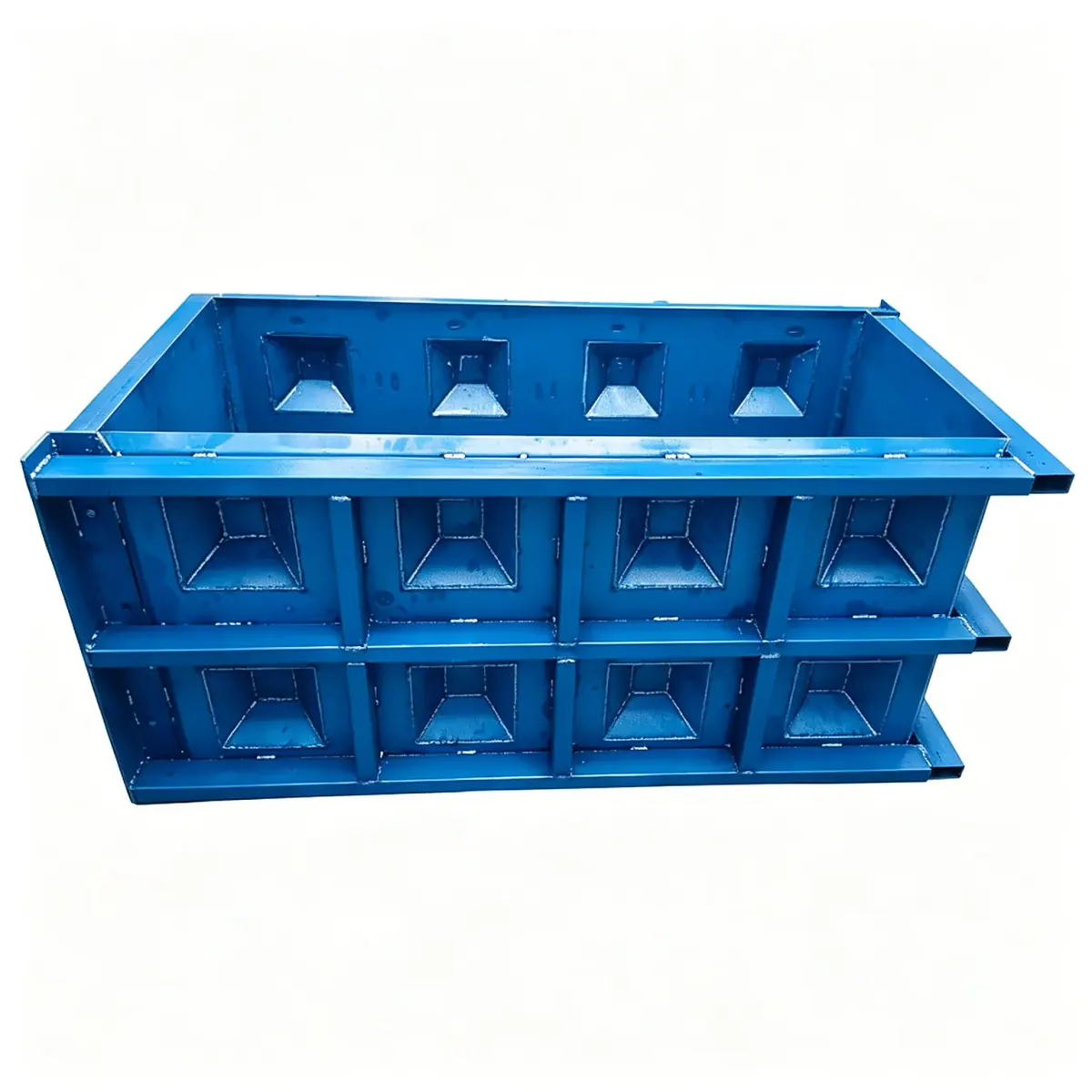
Why the Price of a Lego-Style Block Mould Is Not Just Steel Weight
When a contractor asks for a quotation on a Lego-style interlocking block mould, the first instinct is to compare price per kilogram of steel. That approach misses the point. A 6 mm panel mould with fully welded ribs and stiffeners can weigh 30% more than a 4 mm panel mould of the same block size, yet the heavier mould may cost only 15% more because the real cost drivers are welding hours, jig time, and tolerance control—not raw steel. This article breaks down the cost structure from the workshop floor, so you can see where your money goes and where it does not.
1. Steel Grade and Panel Thickness: The Visible Cost
All our moulds are made from Q235 carbon steel, a standard structural grade with good weldability and strength. The panel thickness ranges from 3 mm to 6 mm. For Lego-style interlocking blocks used in retaining walls and revetments, we typically recommend 4 mm or 5 mm panels for the block faces and 6 mm for the interlocking tongues and grooves, which take the most wear during stripping.
Steel cost is roughly proportional to weight. A 4 mm panel weighs about 31.4 kg per square meter, while a 6 mm panel weighs 47.1 kg per square meter. For a mould producing a block of 500 x 300 x 200 mm, the total steel weight might be 80–120 kg. The difference between 4 mm and 6 mm panels on such a mould is around 15–20 kg, which at current Q235 prices translates to a material cost difference of USD 12–18. That is small compared to the total mould price, which typically ranges from USD 800 to 2,500 depending on complexity. So why do buyers often insist on thicker panels? Because thicker panels resist deformation during concrete pouring and vibration, extending mould life. But thicker panels also increase welding time and handling weight, which we will cover next.
2. Welding and Rib Stiffening: The Hidden Labor Cost
The ribs and stiffeners are what keep a 4 mm panel flat under pour rates of 1.5–2.0 m/hr. A typical Lego-style block mould has a grid of 50 x 50 mm or 60 x 60 mm ribs welded to the back of each panel. The number of ribs depends on block size and panel thickness: a 4 mm panel needs ribs every 250–300 mm, while a 6 mm panel can go 350–400 mm without deflection. Each rib is fillet-welded along its length, and each intersection is welded to prevent stress cracking.
Welding time is the single largest labor component. A standard mould with 4 mm panels and 20 ribs might take 6–8 hours of welding. If you specify 6 mm panels with the same rib spacing, welding time increases by 20–30% because of higher heat input and the need for back-step welding to control distortion. At a workshop rate of USD 15–25 per hour, that extra welding adds USD 30–60 to the mould cost. This is why a heavier mould is not always proportionally more expensive—the labor scales with complexity, not just weight.
We use jig assembly for all rib welding. The jig holds the panel flat and the ribs at exact spacing, which reduces distortion and rework. Without a jig, a welder might spend an extra 2–3 hours straightening a warped panel. That cost is invisible in the quotation but shows up in delivery time and quality.
3. Tolerance and Machining: The Precision Premium
Lego-style blocks rely on interlocking features—tongues and grooves that must fit together on site. Our standard tolerance is ±0.5 mm on all critical dimensions, including the tongue width and groove depth. Achieving this tolerance requires machined edges on the interlocking profiles. The panels are cut on a CNC plasma table, then the edges are milled or ground to final dimension. This machining adds 1–2 hours per mould and requires a skilled operator.
If a buyer accepts ±1.0 mm tolerance, the cost can drop by 10–15% because we can skip the finish machining and rely on laser-cut edges. However, for retaining walls where blocks are stacked 3–4 meters high, a 1 mm mismatch per block can accumulate to 10–20 mm over 20 courses, causing alignment problems and potential structural issues. The precision premium is usually worth paying for load-bearing applications. For landscaping walls under 1.5 m high, a looser tolerance may be acceptable.
4. Order Size and Customization: Economies of Scale
We have no MOQ, but the unit price decreases with quantity. A single custom mould requires full jig setup, programming, and trial assembly, which might take 15–25 working days after deposit. For stock moulds, lead time is 7–10 working days. The cost structure for a one-off custom mould includes USD 300–500 of engineering and jig time that is spread over just one unit. For an order of 10 identical moulds, that same engineering cost is spread over 10 units, reducing the per-unit price by 20–30%.
Customization also affects cost. Adding a company logo, changing the block face texture, or altering the interlocking angle requires new CNC programs and possibly new jigs. Each change can add USD 100–300 to the setup cost. If you need multiple block sizes, consider whether a modular mould design—where common parts are shared—could reduce your total cost. We can advise on this during the quotation stage.
5. Reuse Life: The Long-Term Cost Equation
The purchase price is only part of the cost. The reuse life determines the cost per block. Our standard moulds achieve 60–100 reuses, while heavy-duty designs with 6 mm panels and reinforced ribs reach 120+ reuses. Suppose a standard mould costs USD 1,200 and produces 80 reuses. The mould cost per block is USD 15. A heavy-duty mould costs USD 1,800 but produces 150 reuses, giving a cost per block of USD 12. Over a project of 1,000 blocks, the heavy-duty mould saves USD 3,000—more than the price difference.
However, heavy-duty moulds are not always the right choice. For a small landscaping project of 200 blocks, the standard mould is more economical because the extra upfront cost is not recovered. The break-even point is typically around 500 blocks. We help buyers calculate this based on their project size.
6. Freight and Documentation: The Landed Cost
All prices are FOB Tianjin. CIF or CFR terms are available on request. A typical mould for a 500 x 300 x 200 mm block weighs about 100 kg and occupies 0.3 cubic meters. A 20-foot container can hold about 25–30 tonnes or 28 cubic meters, so you can fit roughly 80–100 moulds per container if weight is not the limit. For small orders, less-than-container-load (LCL) shipping may be more economical, but handling costs at the port can add USD 200–400.
Documentation includes CI, PL, MTC, CO, and FORM E. FORM E can reduce import duties in ASEAN countries. We provide all documents at no extra cost, but the buyer is responsible for import clearance. Payment terms are 30% deposit by T/T, balance against copy of B/L. This is standard for our industry and protects both parties.
7. Comparing Options: A Cost Breakdown Table
The table below compares three typical configurations for a Lego-style block mould (block size 500 x 300 x 200 mm). Prices are given as typical market ranges, not our quotation.
| Configuration | Panel Thickness | Rib Spacing | Tolerance | Reuse Life | Typical Market Price (USD) | Cost per Block (USD, at 80 reuses) |
|---|---|---|---|---|---|---|
| Economy | 3 mm | 250 mm | ±1.0 mm | 60 | 800 – 1,200 | 13.3 – 20.0 |
| Standard | 4 mm | 300 mm | ±0.5 mm | 80 | 1,200 – 1,800 | 15.0 – 22.5 |
| Heavy-duty | 6 mm | 350 mm | ±0.5 mm | 120+ | 1,800 – 2,500 | 15.0 – 20.8 |
Note: Cost per block is calculated by dividing the mould price by the reuse life. For heavy-duty, using 120 reuses gives a lower cost per block despite higher upfront price.
8. When Not to Choose a Lego-Style Mould
Lego-style interlocking block moulds are ideal for retaining walls, river revetments, and municipal landscaping where speed of installation and structural interlock are priorities. However, they are not the best choice for every project. If your blocks require a highly textured face (e.g., split-face or cobblestone), a polyurethane or rubber mould may be more cost-effective for small quantities, though steel moulds can be engraved at extra cost. If your project is very small (under 100 blocks), the setup cost of a steel mould may not be justified—consider renting or buying used moulds. Also, if your concrete mix contains lightweight aggregates or fibers, the abrasion on the mould may be higher, reducing reuse life; in that case, a 6 mm panel is recommended even for small projects.
Finally, consider the stripping sequence. Lego-style blocks have interlocking features that can lock onto the mould if the draft angle is insufficient. We design moulds with a 1–2 degree draft on all vertical faces to ensure smooth stripping. If you plan to strip blocks immediately after casting (within 24 hours), the mould must be robust enough to withstand the suction; a 3 mm panel may deform under these conditions. Always discuss your stripping schedule with us before finalizing the specification.
Conclusion: Where Your Money Goes
In a Lego-style block mould, roughly 40–50% of the cost is steel and machining, 30–40% is welding and assembly labor, and 10–20% is engineering, jig setup, and overhead. The cheapest mould is not always the most economical—reuse life and tolerance control often matter more. By understanding these cost drivers, you can specify a mould that balances upfront price with long-term performance. Contact us with your block dimensions and project size, and we will provide a detailed quotation with transparent cost breakdown.