
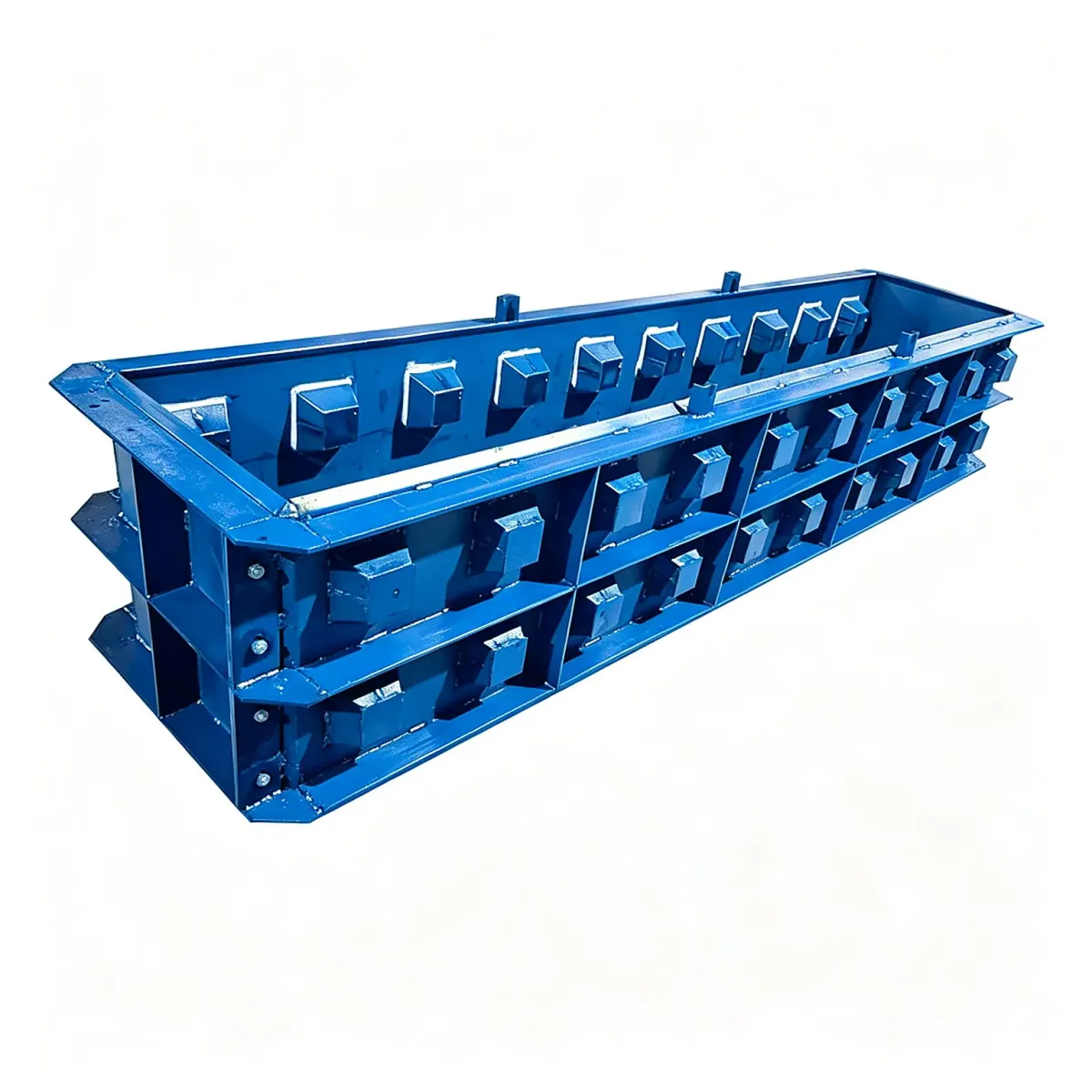
Why Lego-Style Interlocking Block Formwork Is Not a Commodity
Lego-style interlocking block formwork is a matched set of steel moulds that cast blocks with male-female projections and recesses, allowing dry-stacked, self-aligning walls. Unlike standard rectangular block moulds, the interlocking geometry demands precise jig assembly and welding to maintain ±0.5 mm tolerance on the tongue-and-groove profiles. If the male nose is 1 mm too wide, blocks jam on site; 1 mm too narrow, and the wall loses shear capacity. This article gives you seven selection criteria, with the arithmetic behind each, so you can specify the right formwork for retaining walls, river revetment, or municipal landscaping.
1. Panel Thickness: 3 mm vs. 4 mm vs. 6 mm Steel
The first decision is steel panel thickness. Our standard Lego-style moulds use 3–6 mm Q235 carbon steel panels, fully welded to ribs and stiffeners. Thicker panels resist bulging under concrete pressure but add weight and cost. Use the following table to match thickness to your pour rate and block size.
| Panel Thickness | Recommended Pour Rate | Max Block Height | Reuse Cycles (standard) | Typical Market Range (USD/m²) |
|---|---|---|---|---|
| 3 mm | ≤ 1.5 m/hr | 300 mm | 60–80 | $180–$240 |
| 4 mm | ≤ 2.5 m/hr | 400 mm | 80–100 | $240–$320 |
| 6 mm | ≤ 4.0 m/hr | 500 mm | 100–120+ | $320–$420 |
When NOT to choose 6 mm: If your precast plant uses a 1 m³ skip and pours at 1.2 m/hr, 6 mm panels are overkill. You will pay 30–40% more and handle heavier moulds (a 1.2 m × 0.6 m panel in 6 mm weighs about 34 kg vs. 17 kg in 3 mm), slowing stripping and increasing crane time. For low-volume landscaping projects with fewer than 5,000 blocks, 3 mm is the economical choice.
2. Rib and Stiffener Design: The Hidden Cost Driver
Lego-style blocks have deep interlocking features, so the mould needs ribs that reach into the recesses without blocking concrete flow. We weld 50 mm × 6 mm flat bars as stiffeners on the back of each panel, spaced at 300 mm centers. This spacing keeps panel deflection under 1.5 mm at 2.5 m/hr pour rate. If a supplier offers 400 mm spacing, expect 2–3 mm deflection, which translates to block height variation of ±2 mm—enough to cause rocking in dry-stacked walls.
Check the welding process: we use MIG welding for ribs and spot welding for jig assembly. Full penetration welds on the interlocking nose are critical; a 2 mm incomplete fusion can crack after 20 reuses. Ask for a weld map or sample section.
3. Stripping Sequence and Draft Angles
Interlocking blocks cannot be stripped vertically—the male projection locks into the female recess. The mould must be designed with a 2–3° draft angle on the interlocking faces and a two-part or sliding core. Our standard design uses a hinged side plate that swings open 45° before the block is lifted. This adds 15–20 seconds per stripping cycle compared to a simple rectangular mould, but prevents chipping.
For high-volume precast plants, consider a multi-cavity mould with 4 or 6 blocks per cycle. A 6-cavity mould for a 400 mm × 200 mm block weighs about 480 kg and requires a 5-tonne overhead crane. The trade-off: higher upfront cost (typical market range $8,000–$12,000) but stripping time per block drops from 45 seconds to 12 seconds.
4. Bolt Torque and Assembly Tolerances
Lego-style formwork is assembled with M16 bolts (grade 8.8) at 120 Nm torque. Under-torquing causes panel separation and concrete flash; over-torquing strips threads. We recommend a calibrated torque wrench and a re-check after the first 10 pours. The jig assembly ensures ±0.5 mm tolerance on the interlocking profiles, but this only holds if the mould is assembled on a flat surface (max 0.5 mm/m deviation).
If you are importing, request a pre-shipment trial assembly report with measured diagonal tolerances. A 1 mm diagonal mismatch on a 1.2 m panel can cause 3 mm misalignment on the wall.
5. Reuse Cycles and Maintenance: 60 vs. 120+
Standard Lego-style moulds with 3–4 mm panels deliver 60–100 reuses. Heavy-duty designs with 6 mm panels and reinforced ribs reach 120+ reuses. The difference is not just thickness—it is the stripping method and cleaning regime. Each reuse requires cleaning the interlocking faces with a soft brush; metal scrapers remove the draft angle and cause jamming.
- Standard mould: 60–100 reuses, ideal for projects under 10,000 blocks.
- Heavy-duty mould: 120+ reuses, for precast plants running 20,000+ blocks per year.
- Key maintenance: Apply release agent every 5 pours; inspect welds every 20 pours.
If your project is a one-off river revetment with 3,000 blocks, a standard 3 mm mould will outlast the project. Buying heavy-duty is wasted capital.
6. Lead Time, Payment, and Shipping Arithmetic
Lead time for stock moulds is 7–10 working days; customised formwork takes 15–25 working days after deposit. Payment terms: 30% deposit by T/T, balance against copy of B/L. We ship FOB Tianjin, with CIF/CFR available on request. Documents include CI, PL, MTC, CO, and FORM E.
Container loading: a 20 ft container holds approximately 25–30 m² of assembled Lego-style moulds (depending on panel size). A 40 ft container holds 55–65 m². For a typical retaining wall project needing 200 m² of formwork, you are looking at 4 × 20 ft containers or 2 × 40 ft containers. Sea freight from Tianjin to Rotterdam is typically 30–35 days; to Los Angeles, 18–22 days.
No MOQ applies, but for orders under 20 m², the per-unit shipping cost can double. We recommend consolidating with other moulds or ordering a full container.
7. When Lego-Style Formwork Is the Wrong Choice
Lego-style interlocking block formwork excels for retaining walls up to 3 m high and river revetment with curves. But it is not for every project:
- Not for high-seismic zones: Dry-stacked interlocking blocks rely on friction and gravity. In seismic zones requiring reinforcement, you need grouted or reinforced block formwork.
- Not for very tall walls: Above 3 m, the base block crushes unless you use geogrid reinforcement. The formwork itself is fine, but the wall design changes.
- Not for tiny batches: If you need 500 blocks for a garden wall, the setup cost of steel moulds (typical market range $2,000–$4,000) is hard to justify. Consider timber or plastic moulds.
For municipal landscaping with repetitive curves, Lego-style formwork pays back in 2–3 projects because the blocks self-align and require no mortar.
Selection Checklist for Buyers
Before you request a quotation, gather these data points:
- Block dimensions (length × width × height) and interlocking profile drawing.
- Required production rate (blocks per day) and available crane capacity.
- Concrete mix design and slump (affects pour rate and pressure).
- Project duration and total block quantity (to calculate reuse cycles).
- Destination port and preferred Incoterm (FOB, CIF, CFR).
With these, we can recommend panel thickness, rib spacing, and cavity number. Remember: the cheapest mould is rarely the lowest cost per block. A 6 mm heavy-duty mould at $380/m² that lasts 120 reuses costs $3.17 per reuse; a 3 mm mould at $200/m² that lasts 60 reuses costs $3.33 per reuse. The heavy-duty option is actually cheaper per block—if you have the volume.
Final Recommendation
For retaining walls and river revetment under 3 m, choose 4 mm panels with 300 mm rib spacing—it balances weight, pour rate, and reuse. For precast plants running 20,000+ blocks per year, invest in 6 mm heavy-duty moulds with multi-cavity design. Always verify the interlocking tolerance with a trial assembly, and confirm the stripping sequence matches your crane and labor. With lead times of 7–25 working days and no MOQ, you can start small and scale up. Contact us with your block profile for a tailored selection.