


Why the Price of a Lego-Style Block Mould Varies by 40% Between Suppliers
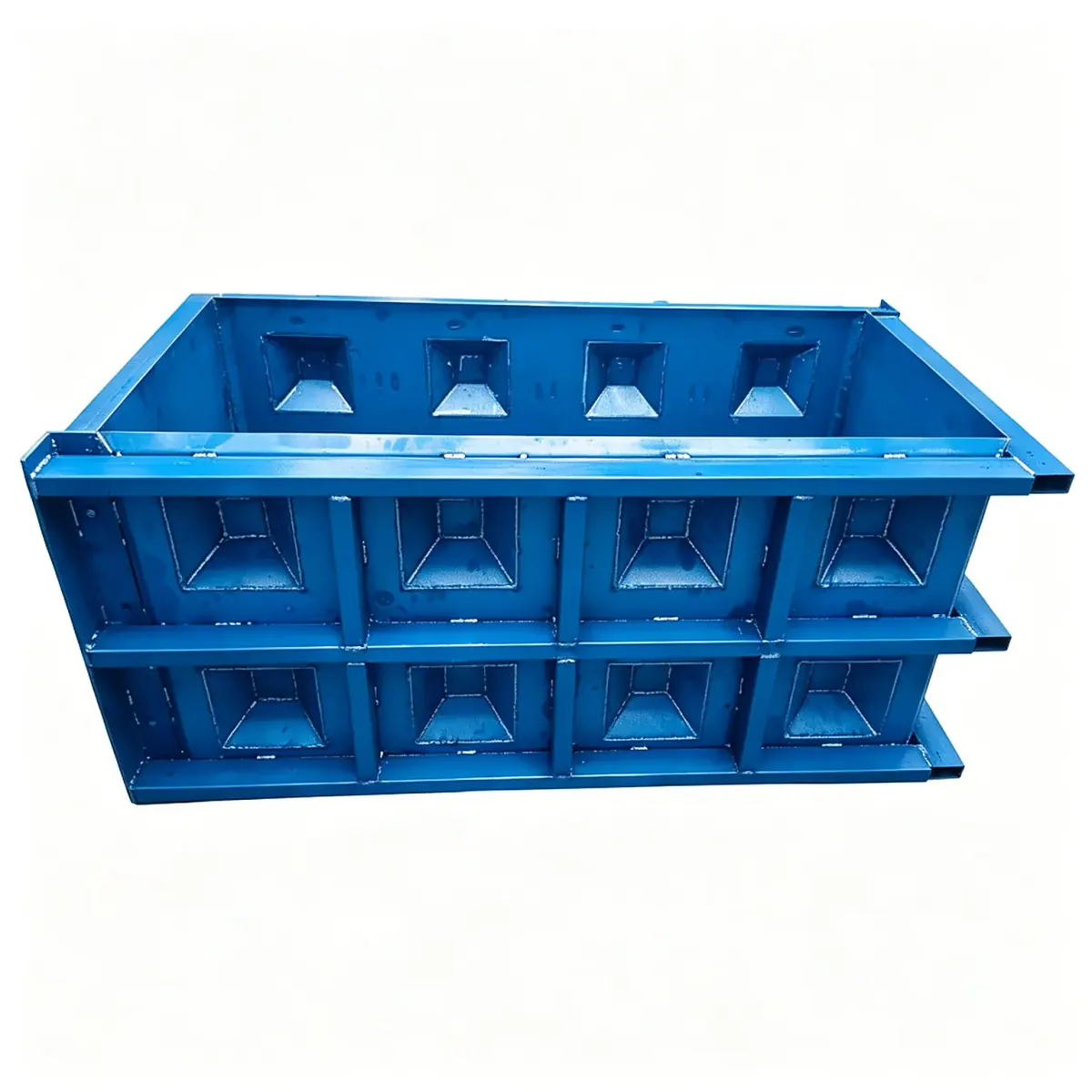
If you are sourcing formwork for Lego-style interlocking blocks used in retaining walls or river revetment, you have probably seen quotes ranging from USD 1,200 to USD 2,800 for what looks like the same mould. The difference is not just margin—it is the steel gauge, the welding sequence, the jig time, and the tolerance you accept. This article breaks down the cost structure from the workshop floor, so you can see exactly where your money goes and which specifications actually matter for your project.
1. Steel Panel Thickness: The Biggest Cost Lever
Our Lego-style moulds are built from Q235 carbon steel, but the panel thickness you choose directly drives material cost and mould life. Standard moulds use 3–4 mm panels, while heavy-duty designs for high-cycle precast plants use 5–6 mm panels. The price difference between a 3 mm and a 6 mm mould is roughly 25–35% because steel accounts for about half the total cost.
Thicker panels resist deflection during concrete pouring, especially when you pour at rates above 1.5 m/hr. For river revetment blocks that are often 400–600 mm high, a 3 mm panel may bow after 60–80 reuses, while a 6 mm panel with fully welded ribs can exceed 120 reuses. The arithmetic: if a 3 mm mould costs USD 1,500 and lasts 70 cycles, your cost per block is USD 0.021; a 6 mm mould at USD 2,100 lasting 130 cycles costs USD 0.016 per block—24% cheaper per unit over its life.
| Panel Thickness | Typical Reuses | Best For | Relative Cost |
|---|---|---|---|
| 3 mm | 60–80 | Low-volume landscaping, trial orders | Baseline |
| 4 mm | 80–100 | Municipal projects, moderate cycles | +10–15% |
| 5 mm | 100–120 | Retaining walls, frequent pours | +20–25% |
| 6 mm | 120+ | High-cycle precast plants | +30–35% |
2. Welding and Rib Design: Where Cheap Moulds Fail
A Lego-style block has interlocking features—tongues, grooves, or dovetails—that require precise alignment. The mould must hold these features within ±0.5 mm across the entire cavity. To achieve this, we fully weld internal ribs and stiffeners, not just tack-weld them. A typical 500 mm high block mould has 6–8 ribs on the back of each face, each welded with a 3–4 mm fillet along its full length. This welding takes time: about 2.5 hours per mould for a standard design, versus 45 minutes for a spot-welded import.
Spot-welded ribs are the hidden cost trap. They look fine on delivery, but after 20–30 stripping cycles, the welds crack and the panel distorts. Your interlocking tolerance opens up, and blocks start to fit poorly on site. If a supplier quotes you a price 30% below the market, ask how many ribs are fully welded and what the fillet size is. The answer usually explains the gap.
- Fully welded ribs: 6–8 per face, 3–4 mm fillet, 2.5 hours welding time.
- Tack-welded ribs: 2–3 spot welds per rib, 45 minutes, fails after 20–30 cycles.
- No ribs: thin panels rely on edge flanges only—deflection guaranteed at pour rates above 1 m/hr.
3. Jig Assembly and Tolerance: The Invisible Cost
Interlocking blocks only work if the tongue and groove align. We assemble each mould on a machined jig that holds the cavity within ±0.5 mm during welding. This jig time adds about 1.5 hours per mould and requires a skilled fitter. Without a jig, panels are aligned by eye or with simple clamps, and the tolerance drifts to ±2 mm or worse. For a retaining wall where blocks stack 10 high, a 2 mm misalignment per block becomes a 20 mm cumulative error—enough to cause visible steps and weak joints.
Customised formwork with special interlocking profiles (e.g., curved revetment blocks) may need a dedicated jig, adding 3–5 working days to the lead time and USD 300–600 to the tooling cost. This is a one-time cost per design, not per mould, so it amortises quickly on orders above 10 units.
4. Order Size and Lead Time: How Volume Changes the Price
We have no MOQ, but the unit price drops as order size increases because setup and jig costs are spread across more moulds. A single custom mould might carry USD 500 of jig time; an order of 20 moulds spreads that to USD 25 each. Stock moulds (standard Lego profiles) ship in 7–10 working days and avoid jig costs entirely. Customised formwork takes 15–25 working days after deposit.
Freight also matters. A 20-foot container holds about 12–15 standard block moulds (depending on size), while a 40-foot container holds 25–30. If you order 10 moulds, you pay for a 20-foot container; if you can consolidate to 25, your per-unit freight drops by roughly 40%. We ship FOB Tianjin, with CIF/CFR available on request.
Tip: If your project needs 8 moulds, consider ordering 12 and keeping 4 as spares. The freight per mould drops, and you avoid production downtime when a mould is being maintained.
5. Stripping Sequence and Bolt Torque: Design Choices That Affect Cost
Lego-style blocks often have complex geometry, so the mould must open cleanly without damaging the concrete. We design side-hinged or bolt-together moulds. Bolt-together designs are cheaper to make (no hinges) but slower to strip: each mould has 8–12 bolts that must be torqued to 40–50 Nm and loosened for each cycle. Hinged designs cost 15–20% more but reduce stripping time by 30–40%, which matters if you are producing 50+ blocks per day.
For high-cycle plants, we recommend a tapered cavity with a 1–2 mm draft per side. This small taper adds machining time (about 30 minutes per mould) but eliminates sticking and reduces stripping damage. The cost increase is typically 5–8%, but it can extend mould life by 20%.
6. When NOT to Choose a Heavy-Duty Mould
Heavy-duty 6 mm moulds are not always the right choice. If you are producing fewer than 50 blocks total for a small landscaping project, a 3 mm mould at USD 1,200–1,500 is sufficient. The extra USD 600–900 for a 6 mm mould will never pay back. Similarly, if your concrete mix is lightweight or you pour slowly (under 0.5 m/hr), panel deflection is less of an issue, and 4 mm is adequate.
Also consider your stripping method: if you have a tilting table or vacuum lifter, thinner panels may be fine. If you strip by hand with pry bars, thicker panels resist bending. Be honest about your production volume—over-specifying wastes money; under-specifying wastes moulds.
7. Putting It All Together: A Sample Cost Breakdown
Here is a typical market range breakdown for a standard 500×300×200 mm Lego-style block mould, based on our workshop data. These are not our quotations but illustrate the cost structure.
| Cost Component | Share of Total Cost | Notes |
|---|---|---|
| Steel material (Q235) | 45–55% | Driven by panel thickness and rib count |
| Welding labour | 20–25% | Fully welded ribs take 2.5 hours |
| Jig assembly & machining | 10–15% | ±0.5 mm tolerance requires jig time |
| Surface treatment | 5–8% | Shot blasting and primer |
| Overhead & margin | 10–15% | Varies by supplier |
As you can see, steel and welding together account for 65–80% of the cost. That is why a supplier who cuts corners on steel thickness or welding time can offer a much lower price—and why you should always ask for the steel gauge and welding details before comparing quotes.
8. Documents and Payment: The Fine Print That Affects Your Landed Cost
We provide CI, PL, MTC, CO, and FORM E with every shipment. FORM E can reduce import duties in ASEAN countries, which effectively lowers your landed cost by 5–10% compared to suppliers who cannot provide it. Payment terms are 30% deposit by T/T, balance against copy of B/L. This is standard for our industry, but be aware that some suppliers ask for 100% upfront—avoid that if possible, as it removes your leverage if quality issues arise.
When comparing quotes, always calculate the landed cost: FOB price + freight + insurance + duties + port charges. A mould that is USD 200 cheaper FOB but ships from a port with fewer sailings could cost you more in delays. We ship from Tianjin, one of China's busiest ports, with frequent sailings to Southeast Asia, the Middle East, and Africa.
Conclusion: Focus on Cost per Block, Not Price per Mould
The cheapest mould is rarely the most economical. Calculate your cost per block by dividing the mould price by its expected reuses. A USD 2,100 heavy-duty mould that lasts 130 cycles costs USD 16.15 per cycle; a USD 1,500 light mould that lasts 70 cycles costs USD 21.43 per cycle—33% more expensive per block. Add the cost of downtime and poor block quality, and the cheap option looks even worse. Use the breakdown above to ask the right questions, and you will get a mould that pays for itself.