


Why steel formwork price for precast is not a single number
When you request a price for steel formwork for precast concrete, you are not buying a commodity like rebar or cement. You are buying a custom-built tool that must hold ±0.5 mm tolerance across hundreds of reuses. The price you see on a quotation is the sum of seven cost drivers: steel grade and thickness, rib and stiffener design, welding and jig assembly, machining and tolerance, surface finish, order quantity, and delivery terms. Change any one of these and the price moves — sometimes by 30% or more. This article breaks down each driver from the workshop floor, so you can compare quotes intelligently and avoid the trap of the lowest headline price.
1. Steel grade and panel thickness: the first price lever
All our formwork is made from Q235 carbon steel, a common structural steel with good weldability and strength. But Q235 is not a single product: it comes in plates from 3 mm to 6 mm thickness. For precast formwork, panel thickness is the biggest single cost driver because steel is priced by weight. A 6 mm panel weighs roughly twice as much as a 3 mm panel per square metre. For a typical wall panel mould of 3 m × 1.5 m, moving from 3 mm to 6 mm adds about 106 kg of steel per panel — at a typical market range of USD 600–900 per tonne for fabricated formwork, that is USD 64–95 extra per panel before any other changes.
When do you need 6 mm? When the formwork will be used for 120+ reuses (heavy-duty design) or when concrete pour rate exceeds 2 m/hr and internal vibration is intense. For standard moulds with 60–100 reuses and pour rates under 1.5 m/hr, 4 mm or 5 mm panels are usually sufficient. Do not choose 6 mm “just to be safe” — you pay for steel you may never need, and the extra weight increases handling and transport costs.
2. Ribs and stiffeners: the hidden cost of rigidity
Panel thickness alone does not determine stiffness. The ribs and stiffeners — the welded frame behind the panel — carry most of the load. A fully welded rib design with 50 mm × 5 mm flat bars at 300 mm centres costs more in labour and material than a lighter 40 mm × 4 mm rib at 400 mm centres. But the lighter design may deflect under pour pressure, causing bulging and rejected precast units. The arithmetic: a 3 m × 1.5 m panel with 50×5 ribs at 300 mm centres uses about 18 kg more steel than the lighter option, adding roughly USD 11–16 per panel at typical market rates. That is cheap insurance against a USD 500 rejected panel.
Ask your supplier for the rib spacing and size in writing. If they cannot provide it, the price is not comparable.
3. Welding and jig assembly: labour is 30–40% of cost
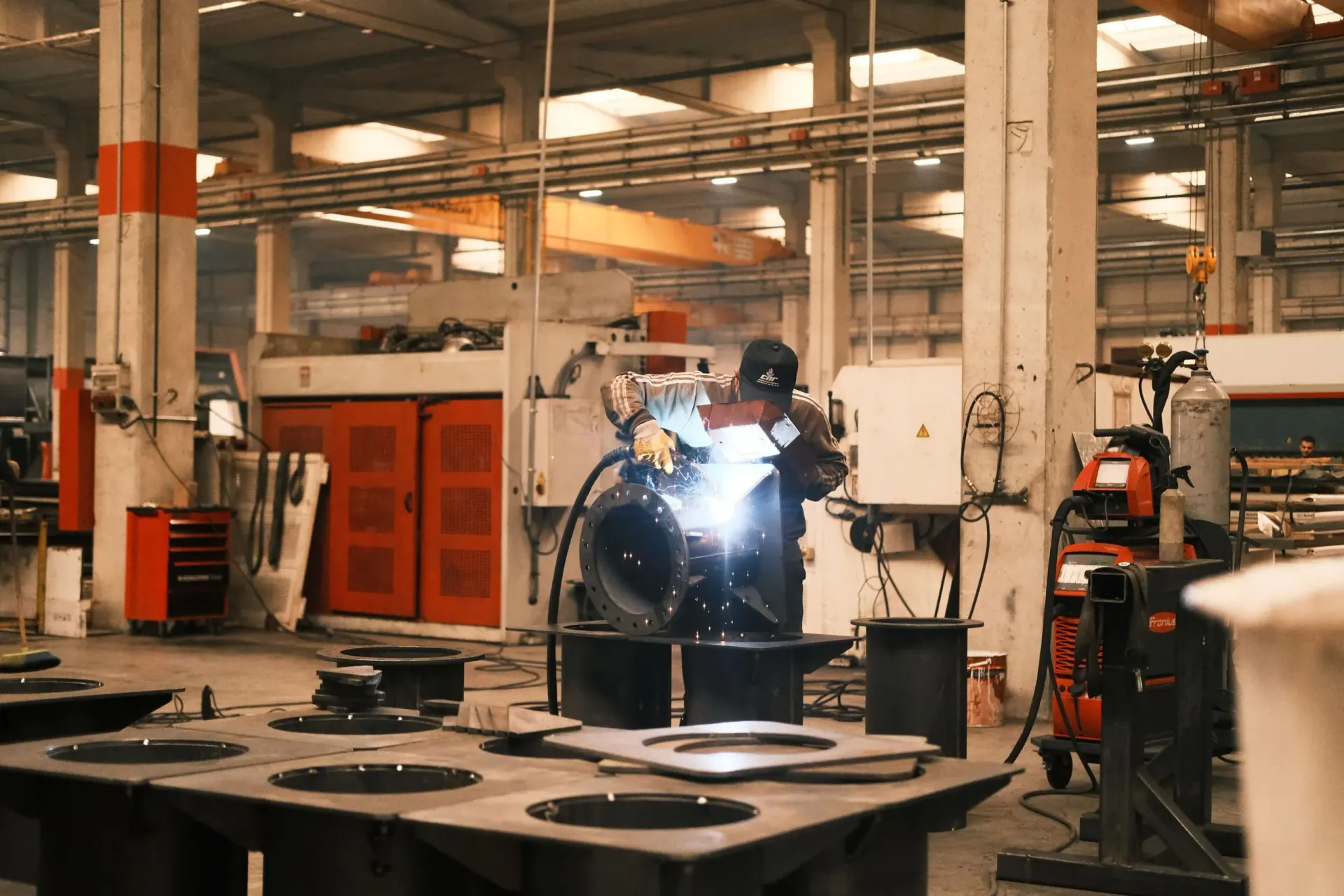
Steel formwork is not just cut steel; it is welded assembly. The workshop process matters: panels are cut, bevelled, and tack-welded into a jig that holds them square and flat. Full welding of ribs and stiffeners follows, then stress-relieving (for heavy-duty designs) and machining of mating surfaces. A jig-built mould with continuous 6 mm fillet welds takes about 12–16 man-hours for a standard wall panel mould. A cheaper mould with skip welding and no jig may take 6–8 man-hours, but it will distort after 20–30 reuses. Labour rates in China are typically USD 6–10 per hour for skilled welders, so the difference is USD 40–80 per mould — again small compared to the cost of premature failure.
Lead time also reflects welding hours: stock moulds ship in 7–10 working days, customised formwork in 15–25 working days after deposit. If a supplier promises custom formwork in 7 days, they are either skipping jig assembly or have a very large stock of semi-finished parts.
4. Tolerance and machining: ±0.5 mm costs more than ±2 mm
Precast concrete elements often need to fit together on site with 2–3 mm joints. That means formwork tolerance must be tighter than the finished product. Our standard tolerance is ±0.5 mm on critical dimensions, achieved by machining mating surfaces after welding. A supplier offering ±2 mm tolerance can skip machining and simply weld and grind, saving perhaps USD 30–50 per mould. But if you are producing precast wall panels that must align vertically, ±2 mm accumulates over 10 panels to 20 mm — enough to cause visible misalignment and costly site fixes.
When is ±2 mm acceptable? For non-critical elements like temporary fencing bases or bulk fill blocks. For structural precast, insist on ±0.5 mm and ask for a first-article inspection report.
5. Surface finish: mill scale vs. machined vs. polished
The mould surface determines the appearance of your precast concrete. Standard Q235 steel comes with mill scale, which transfers a rough, dark finish to concrete. For architectural precast, you need a machined or polished surface. Machining a 3 m × 1.5 m panel on a large planer mill adds about 2–3 hours of machine time, costing USD 40–60 at typical shop rates. Polishing to a mirror finish adds another USD 30–50. If your client accepts a standard finish, skip these costs. If you are producing exposed concrete, budget for them.
6. Order quantity and container loading
Steel formwork is bulky and heavy. A 20-foot container can hold about 20–25 tonnes of formwork, but volume often limits before weight. For standard wall panel moulds, you might fit 15–20 moulds per 20-foot container. Ordering a full container reduces per-unit freight and handling. There is no MOQ — we ship single moulds — but the unit price will be higher because setup costs (cutting, jigging, welding) are spread over fewer pieces. A typical market range for a standard wall panel mould is USD 800–1,500 FOB Tianjin, depending on size and specification. For orders above 20 tonnes, expect a discount of 5–10%.
7. Delivery terms and documentation
Our prices are FOB Tianjin by default; CIF or CFR are available on request. Payment is 30% deposit by T/T, balance against copy of B/L. Documents provided: CI, PL, MTC, CO, and FORM E (for ASEAN buyers). If you need FORM E, confirm with your supplier before booking, as it affects lead time by 1–2 days. Do not compare FOB prices from different suppliers without adjusting for freight and insurance — a CIF price can be 10–15% higher than FOB for the same goods.
How to calculate cost per reuse: the only number that matters
The headline price is meaningless without reuse. A mould that costs USD 1,200 and lasts 100 reuses costs USD 12 per use. A cheaper mould at USD 900 that lasts 40 reuses costs USD 22.50 per use — nearly double. Use this formula:
Cost per reuse = (Purchase price + maintenance cost) ÷ Number of reuses
Maintenance for steel formwork is mainly cleaning and occasional re-machining of mating surfaces. Budget 2–3% of purchase price per year for maintenance. Heavy-duty designs (120+ reuses) typically cost 20–30% more upfront but reduce cost per reuse by 40–50% over standard designs.
Comparison table: standard vs. heavy-duty steel formwork
| Parameter | Standard mould | Heavy-duty mould |
|---|---|---|
| Panel thickness | 3–5 mm | 5–6 mm |
| Rib size and spacing | 40×4 mm at 400 mm | 50×5 mm at 300 mm |
| Welding | Skip welding on non-critical joints | Continuous 6 mm fillet welds |
| Tolerance | ±0.5 mm on critical dimensions | ±0.5 mm, stress-relieved |
| Reuse (typical) | 60–100 | 120+ |
| Typical market range (FOB Tianjin) | USD 800–1,200 per mould | USD 1,200–1,800 per mould |
| Best for | Short-run precast, standard elements | High-volume precast, architectural panels |
When NOT to choose steel formwork
Steel formwork is not always the right answer. If you are producing fewer than 20 reuses of a given element, plywood or timber formwork may be cheaper despite lower durability. If your precast elements are highly complex with many undercuts, steel may be too expensive to fabricate — consider rubber or GRP moulds. And if your project is in a remote area with no crane access, the weight of steel (a 3 m × 1.5 m mould weighs about 250–350 kg) may be a handling problem. Be honest about your production volume before choosing steel.
Checklist for comparing steel formwork quotes
- Panel thickness in mm — ask for the exact figure, not “standard”.
- Rib size and spacing — request a drawing.
- Welding specification — continuous or skip? Fillet size?
- Tolerance — ±0.5 mm or ±2 mm? On which dimensions?
- Surface finish — mill scale, machined, or polished?
- Reuse guarantee — written statement of expected reuses.
- Lead time — 7–10 days for stock, 15–25 days for custom.
- Documentation — MTC, CO, FORM E included?
- Payment terms — 30% deposit, balance against B/L copy.
- Freight terms — FOB, CIF, or CFR? Compare like with like.
Use this checklist to build a comparison matrix. The lowest price is rarely the lowest cost.