
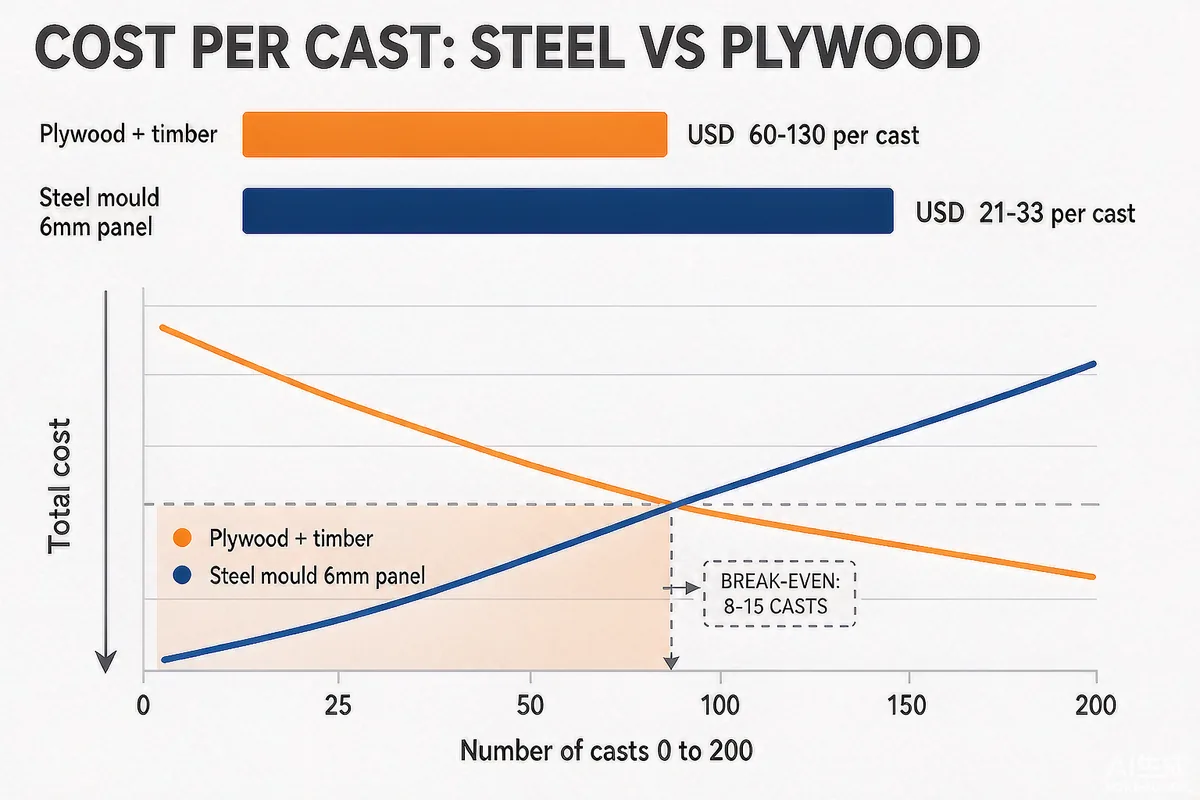
Every formwork buyer faces the same question, and the answer is almost never "steel is better". It depends on a single number: how many times you will reuse the mould. Below is the arithmetic we walk through with customers, using figures from our own 2025-2026 quotations and project records.

The upfront price gap
For a typical box culvert unit (3 m span, 1.5 m height, 1 m length), quoted FOB Tianjin:
| Option | Cost per unit | Expected reuses | Cost per cast |
|---|---|---|---|
| Plywood + timber bracing | USD 380 – 620 | 4 – 8 | USD 60 – 130 |
| Steel mould, 4 mm panel | USD 2,100 – 2,800 | 60 – 90 | USD 26 – 42 |
| Steel mould, 6 mm panel | USD 3,200 – 4,400 | 120 – 180 | USD 21 – 33 |
The crossover sits at roughly 8 to 15 casts. Below that, plywood wins on pure materials cost. Above it, steel wins — and the gap widens fast.
What the price difference does not include
Materials are only about 55-65% of the real difference. Four other lines matter just as much:
- Labour per cast. A plywood mould for a 3 m culvert takes 2 workers roughly 6-8 hours to erect, brace and strip. The steel equivalent takes 2 workers 2.5-3.5 hours, because the panels are self-aligning and the bracing is welded in. At USD 18/hour that is USD 130-180 saved per cast.
- Waste and disposal. Plywood panels delaminate after 4-8 casts. Damaged panels cannot be repaired, only replaced. Budget 12-18% of the original plywood cost per 10 casts in replacement panels.
- Dimensional drift. Timber swells and the bracing loosens. By the fourth cast, a plywood mould typically drifts 4-8 mm out of tolerance across a 3 m span. If your client's specification is ±5 mm, that mould has a fixed life of about 4 casts regardless of how good the plywood was.
- Surface finish. Steel gives a consistent finish straight off the panel. Plywood needs a release agent reapplied every cast and still leaves grain transfer on roughly 1 cast in 5, which then needs patching.
The break-even calculation, worked through
A contractor in Thailand casting 60 box culvert units over 14 months:
- Plywood route: 60 casts ÷ 6 reuses = 10 sets. 10 × USD 500 = USD 5,000. Labour 60 × 7 h × 2 × USD 12 = USD 10,080. Replacement panels ~USD 900. Total ≈ USD 15,980 (USD 266 per unit).
- Steel route: 2 moulds (allowing one casting set, one curing/cleaning set) = USD 5,600. Labour 60 × 3 h × 2 × USD 12 = USD 4,320. No panel replacement. Total ≈ USD 9,920 (USD 165 per unit).
Steel saves about USD 6,000, or 38%, over the project. But if that same contractor only needed 12 units, plywood would come in roughly USD 2,300 cheaper — because the steel moulds are still only 12/70ths of the way through their life.
When plywood is genuinely the right answer
We turn down steel orders for these cases, because the customer would be wasting money:
- Fewer than 10 units and no prospect of repeat work on the same geometry.
- Non-repeating geometry. A one-off architectural shape, or a project where every unit is dimensionally different.
- Very tight site access. A 6 mm steel panel set for a large culvert can weigh 1.8-2.6 t. If the site has no crane and no hard standing, plywood is the practical answer.
- Short-duration contracts where the mobilisation lead time of a fabricated steel mould (typically 25-40 days) exceeds the whole casting programme.
When steel pays back immediately
- Repeat geometry. Anything cast more than 15 times — bridge piers, standard culverts, drainage channels, retaining wall panels.
- Tight tolerance specs. Anything specified at ±5 mm or better. Steel holds it; timber does not.
- High labour cost markets. In markets where a formwork carpenter costs USD 25-40/hour, the labour saving alone repays a steel mould in 10-14 casts.
- Winter or monsoon casting. Timber absorbs water and swells; steel does not. In humid climates the reuse gap between steel and plywood widens from 10:1 to 15:1.
Panel thickness: the choice that decides mould life
The single biggest driver of steel mould life is panel thickness, not the steel grade:
| Panel | Typical reuses | Weight penalty | Best for |
|---|---|---|---|
| 4 mm | 60 – 90 | baseline | Light, low-pressure sections: drainage, small culverts |
| 5 mm | 90 – 130 | +18% | General precast work — the usual recommendation |
| 6 mm | 120 – 180 | +40% | Deep sections, high pour rates, tall columns |
| 8 mm | 200 + | +75% | Mass concrete, walls over 3 m, architectural finish |
All panels are Q235B or Q355B with welded rib stiffeners at 300-400 mm centres. Going below 4 mm on a section with more than 1.5 m of head pressure will show as visible bulging within the first ten casts — we have replaced enough of those to stop quoting them.
The number to calculate before you ask for a quote
Before requesting pricing, work out total projected casts of that geometry on that project, plus any follow-on projects within 24 months. If the answer is under 10 and you have no repeat work, buy plywood. If it is over 15, ask for a steel quote — and ask specifically about panel thickness, because that is where the life of the mould is decided.