
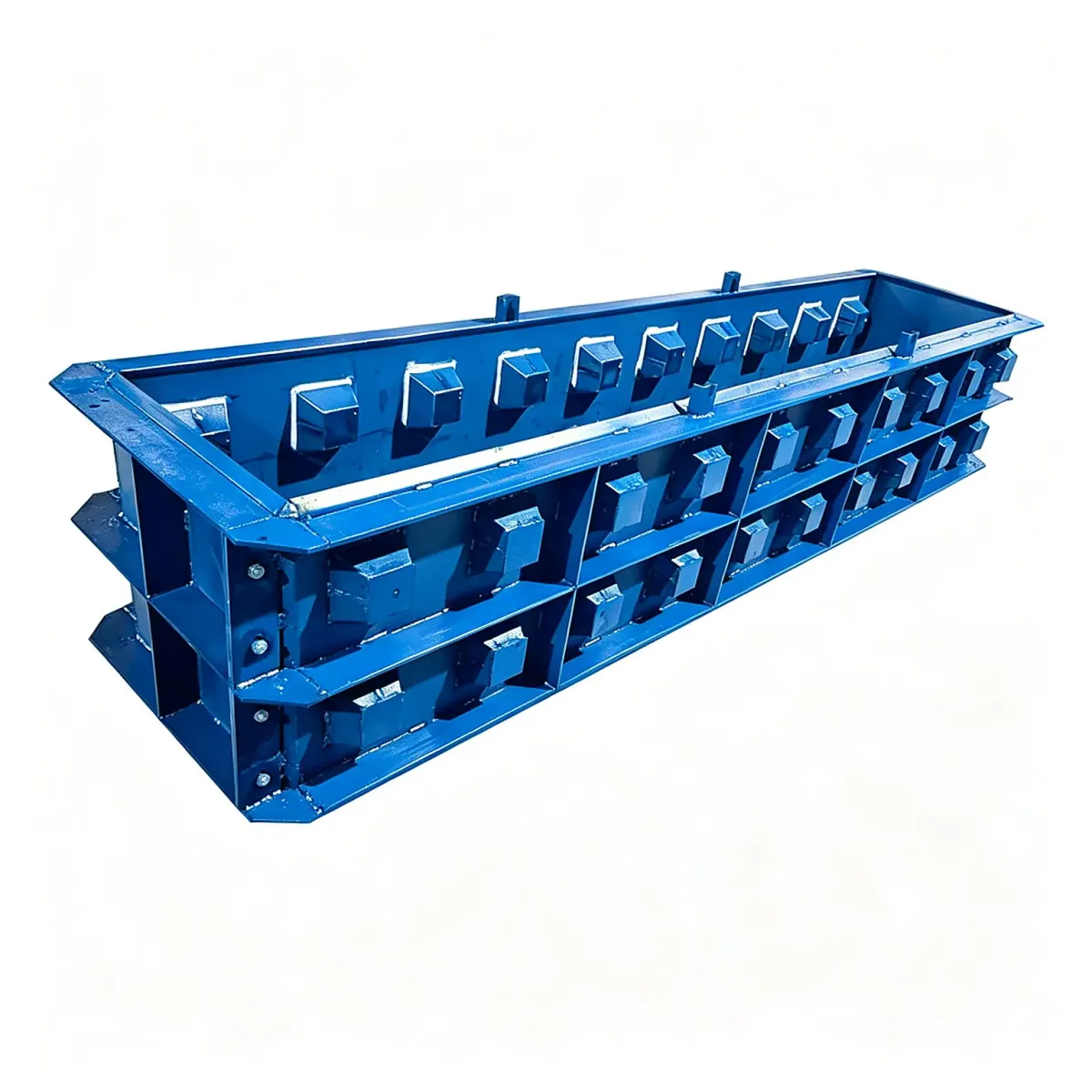
Why the Interlocking Mechanism Dictates Your Formwork Choice
The interlocking mechanism—whether a tongue-and-groove, dovetail, or shear-key profile—is the first thing that separates one Lego-style block formwork from another. A 3 mm steel panel might survive 60 reuses with a simple trapezoidal key, but a complex dovetail with undercuts demands 5–6 mm panels and fully welded stiffeners to resist the lateral pressure of a 75 MPa mix. If your project calls for a 200 mm thick retaining wall block with a 15 mm deep interlock, the mould's rib spacing must not exceed 300 mm to prevent panel bulging. Ask your supplier for the welding jig tolerance: we hold +/-0.5 mm on all interlock faces, which ensures blocks seat without mortar. Without that, you will be grinding concrete on site—a cost of USD 8–12 per m² in labour alone.
Steel Grade and Panel Thickness: The Core Trade-off
All our formwork uses Q235 carbon steel, but the panel thickness you choose determines both reuse and cycle time. For municipal landscaping blocks (often 400x200x200 mm), a 3 mm panel with 40x40x4 mm angle stiffeners is adequate for 60–80 reuses. For river revetment blocks exposed to wave action, you need 5 mm panels and 50x50x5 mm ribs to hit 120+ reuses. The arithmetic: a 3 mm mould costs roughly 15–20% less than a 5 mm mould, but if you plan more than 80 pours, the 5 mm version saves you USD 1,200–1,800 per mould in replacement costs. However, if your project is a one-off 500-block order, the 3 mm mould is the right call—do not over-specify.
| Parameter | Standard Duty (3 mm) | Heavy Duty (5–6 mm) |
|---|---|---|
| Panel thickness | 3 mm | 5–6 mm |
| Rib spacing | 400 mm | 250–300 mm |
| Reuse cycles | 60–100 | 120+ |
| Typical block size | Up to 500x250x200 mm | Up to 1200x600x400 mm |
| Stripping method | Manual knock-out | Hydraulic or mechanical |
| Price index (per mould) | 1.0 | 1.4–1.6 |
Stripping Sequence and Cycle Time: The Hidden Cost
How you strip the block from the mould affects both labour and mould life. For a simple interlocking block with a 5° draft angle, a manual knock-out with a rubber mallet works—cycle time 2–3 minutes per block. But for a block with a 90° interlock face, you need a stripping jig or hydraulic ejector. We design our moulds with a split-line that allows the side panels to hinge open after the core is pulled. This adds USD 300–500 to the mould cost but reduces stripping time to 45–60 seconds and prevents corner chipping. If your precast plant runs two shifts, that saving pays back the jig cost in 8–12 days.
Pour Rate Limits and Concrete Mix Compatibility
Lego-style blocks are often poured with a stiff mix (slump 20–40 mm) to hold the interlock shape. But if you pour too fast, the hydrostatic pressure can distort the mould. For a 3 mm panel, limit the pour rate to 1.5 m/hr; for 5 mm, you can go to 2.5 m/hr. Also, ensure your mix design uses 10 mm aggregate maximum—larger aggregate can lodge in the interlock corners and cause honeycombing. We recommend a vibration frequency of 12,000 vpm applied externally for 15–20 seconds. If you are using self-consolidating concrete (SCC), the pressure is higher; you must reduce the pour rate by 30% or use a heavy-duty mould.
Bolting and Assembly: Torque Matters
Our moulds ship as knock-down kits to save container space—a 20 ft container holds 12–15 standard moulds versus 6–8 fully assembled. Assembly takes 2–3 hours per mould with two workers. The critical step is bolt torque: use M12 grade 8.8 bolts and tighten to 80–90 Nm. Under-torquing causes panel separation and concrete flash; over-torquing strips threads. We include a torque wrench with every first order. After assembly, check diagonal measurements—they should not vary by more than 1 mm across a 1.2 m block.
Cost per Block: The Real Comparison
Buyers often compare mould prices, but the true metric is cost per block. Assume a standard 400x200x200 mm interlocking block. A 3 mm mould costs USD 1,200–1,500 (typical market range) and yields 80 reuses: that is USD 15–19 per block in mould cost. A 5 mm mould costs USD 1,800–2,200 and yields 120 reuses: USD 15–18 per block. The heavy-duty mould wins only if you actually achieve 120 reuses—which requires proper maintenance and a stripping jig. If your project is 2,000 blocks, the 3 mm mould is more economical because you will not reach 120 cycles. Do the math before you buy.
When NOT to Choose Lego-Style Formwork
Lego-style interlocking block formwork is not for every project. If your retaining wall design uses geogrid reinforcement every 300 mm, the interlock may interfere with grid placement—consider a plain block with a shear key instead. If your blocks are smaller than 200x100x100 mm, the interlock detail becomes too fine for 3 mm steel; you need machined aluminium moulds. And if your project requires less than 500 blocks total, the setup cost (assembly, jig, training) outweighs the benefit—rent or buy used moulds. Finally, if your concrete supplier cannot hold a slump below 50 mm, the interlock will slump and you will get rounded edges.
Lead Time, Payment, and Shipping Logistics
For stock moulds, lead time is 7–10 working days after deposit. Customised formwork with your interlock profile takes 15–25 working days. We ship FOB Tianjin; CIF and CFR are available on request. Payment is 30% deposit by T/T, balance against copy of B/L. Documents provided: CI, PL, MTC, CO, and FORM E for ASEAN buyers. There is no MOQ—you can order one mould to test. A 20 ft container holds 12–15 knock-down moulds; a 40 ft holds 28–32. For urgent projects, air freight is possible but adds USD 4–6 per kg.
Maintenance and Storage: Extend Reuse to 120+
To hit the upper reuse range, follow these steps after every pour:
- Clean the interlock faces with a wire brush within 30 minutes of stripping—cured concrete is 3x harder to remove.
- Apply a release agent (water-based) every 3–5 pours; solvent-based agents can attack the weld seams.
- Inspect bolts weekly; re-torque to 80–90 Nm if any are loose.
- Store moulds on a flat pallet, not on the ground, to prevent panel warping. Stack no more than 3 high.
With this routine, a 5 mm mould can exceed 150 reuses in a precast plant environment.
Final Selection Checklist
Before you request a quotation, answer these questions:
- What is the block size and interlock profile? (Send a drawing.)
- How many blocks per project? (This determines panel thickness.)
- What is your concrete mix slump and aggregate size?
- Do you have a stripping jig or hydraulic ejector?
- What is your target cycle time per block?
- Will you assemble in-house or need pre-assembled moulds?
With these answers, we can recommend the exact steel grade, panel thickness, and rib spacing. Remember: the cheapest mould is rarely the lowest cost per block. Choose based on reuse, stripping method, and pour rate—not just price.